
The Disinhibition Practice
by Sachin Rudramuni, Creator of Creator.Express
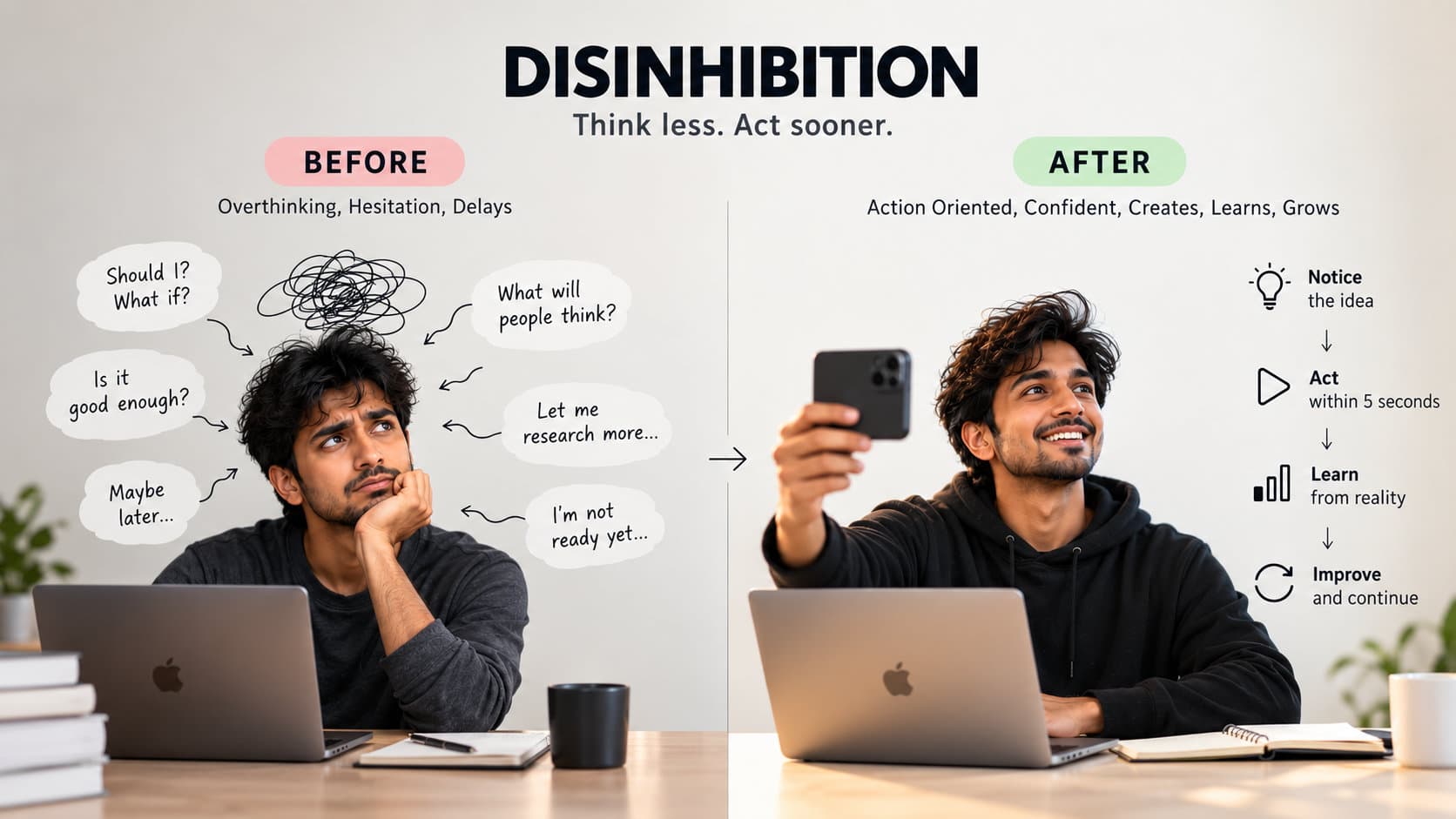
Top tip
If the action is safe, reversible, and low-consequence, move within 5 seconds.
The Disinhibition Practice
Think less. Act sooner. Learn from reality.
1. The core principle
Your current loop may look something like:
Idea → Think → Evaluate → Doubt → Re-evaluate → Prepare → Delay → Maybe act
We want:
Idea → Notice → Act → Observe → Adjust
The practice is to create a tiny gap between thought and action.
Your new rule:
If the action is safe, reversible, and low-consequence, move within 5 seconds.
Examples:
- Thought: “I should record this.” → Open camera.
- Thought: “I should message him.” → Write the first sentence.
- Thought: “This could be a video.” → Record the rough version.
- Thought: “I should ask this question.” → Ask it.
- Thought: “I should publish this.” → Open the publishing screen.
You don't have to finish within five seconds.
You only have to begin.
2. Your three-zone system
Not everything should be done impulsively.
🟢 GREEN — Act immediately
Safe + reversible + low consequence.
Examples:
- Recording a video
- Writing an idea
- Calling a friend
- Asking a normal question
- Trying a new hook
- Posting a draft
- Starting a workout
- Opening your code editor
- Speaking your thought aloud
Rule: 5 seconds.
🟡 YELLOW — Pause briefly
Potentially consequential but manageable.
Examples:
- Sending an important business message
- Publishing something controversial
- Agreeing to a commitment
- Spending significant money
- Making a major product decision
Rule: 5 minutes → review → act.
🔴 RED — Think carefully
Irreversible, dangerous, or legally/financially significant decisions.
Examples:
- Major contracts
- Large financial commitments
- Dangerous physical actions
- Ending important relationships
- Medical decisions
- Anything where an impulsive mistake could seriously harm you or someone else
Disinhibition does NOT apply here.
The skill is not:
“Never think.”
It's:
“Don't use thinking as an excuse to avoid action.”
3. The 5-second practice
This is your fundamental drill.
Whenever you notice yourself thinking:
“I should…”
count:
5 → 4 → 3 → 2 → 1 → MOVE.
Not:
5 → 4 → 3 → Maybe I should…
😂
Physically move.
Stand up.
Open the camera.
Type the first word.
Make the call.
Start the exercise.
Open the document.
Your body becomes the interrupt.
4. The Anti-Perfect-Action Drill
This one is especially useful for content creation.
Every day, intentionally create one imperfect thing.
For example:
- Record a one-take video.
- Don't rehearse.
- Don't watch it afterward.
- Publish something without endlessly optimizing it.
- Write a post in 3 minutes.
- Explain an idea spontaneously.
- Take a photograph without composing it for 5 minutes.
Your objective isn't quality.
Your objective is:
“I can act without needing certainty.”
This trains your nervous system to discover:
Nothing terrible happened.
And that realization is powerful.
5. The Camera Disinhibition Drill
Since recording is one of the areas where this skill can become extremely useful for you:
Level 1 — 30 seconds
Open your camera.
Say whatever you're thinking.
No script.
No second take.
Stop.
Level 2 — 2 minutes
Pick a random topic.
Start recording immediately.
Explain it as though you're talking to one person.
Level 3 — One-take explanation
Give yourself 10 seconds to choose a topic.
Then record a 3–5 minute explanation.
No restart.
Level 4 — Public imperfection
Publish one piece of content without doing your normal excessive optimization.
Then don't check its performance for a predetermined period.
You're training independence from immediate feedback.
6. The “First Thought” exercise
Carry a small notebook or use your phone.
Several times throughout the day, write:
First thought: ______ Action: ______
Example:
First thought: “I should call X.” Action: Called X.
Another:
First thought: “I should record this idea.” Action: Opened camera.
You're teaching yourself to recognize initial intention before analytical machinery takes over.
7. The 10-second decision game
Give yourself tiny decisions throughout the day.
Examples:
What should I eat?
10 seconds.
Which shirt?
10 seconds.
Which topic should I record?
10 seconds.
Which task should I start?
10 seconds.
Then commit.
Don't reopen the decision unless new information appears.
This attacks a particularly sneaky form of overthinking:
decision reopening.
You already decided.
Then your mind says:
“But what if…”
Nope.
Move.
8. Deliberate spontaneity
Once per day, do something mildly spontaneous.
For example:
- Take a different route.
- Talk to someone you normally wouldn't.
- Try a new food.
- Record somewhere different.
- Explain an idea without notes.
- Start a conversation.
- Ask someone an unexpected but respectful question.
- Work from a different environment.
Nothing reckless.
You're simply teaching your brain:
“I don't need to pre-script every experience.”
9. The “No rehearsal” challenge
Once a day:
Pick something you normally rehearse.
Then deliberately don't.
For example:
Instead of:
Think → formulate → refine → rehearse → record
do:
Think → record.
Your first attempt will probably feel uncomfortable.
Good.
That discomfort is part of the training.
You're learning to tolerate:
“I don't know exactly what I'm going to say.”
10. Train the body, not just the mind
Disinhibition isn't purely intellectual.
Use physical cues.
When you notice hesitation:
Do this:
Exhale → relax shoulders → move.
For example:
“Should I record?”
Long exhale.
Relax jaw.
Pick up phone.
Record.
The body movement prevents another 30 seconds of mental negotiation.
11. Your daily 15-minute practice
I'd make this ridiculously simple.
Morning — 5 minutes
5 spontaneous actions
Throughout your morning, whenever you notice a small safe action:
5-4-3-2-1 → GO.
Afternoon — 5 minutes
Spontaneous creation
Pick one:
- 60-second video
- 300-word writing
- spontaneous voice note
- random sketch
- explain an idea
One take.
Evening — 5 minutes
Journal three things:
1. Where did I hesitate?
2. What happened when I acted immediately?
3. What did I learn?
Don't judge yourself.
You're collecting data.
12. The 30-day progression
| Days | Training |
|---|---|
| 1-5 | 5-second rule for tiny actions |
| 6-10 | Spontaneous decisions |
| 11-15 | One-take speaking |
| 16-20 | No-rehearsal conversations/content |
| 21-25 | Deliberate imperfect publishing |
| 26-30 | Combine everything |
By the end, your objective isn't to become impulsive.
It's to make action your default response to low-risk opportunities.
13. The most important distinction
There are actually two different things you might be fighting:
Impulsivity
“I don't think, therefore I act.”
vs.
Disinhibition
“I don't need unnecessary inhibition before I act.”
The second is what I'd train.
You still retain judgment.
You simply stop requiring:
- certainty
- perfection
- confidence
- preparation
- approval
- guaranteed results
before beginning.
Your personal mantra
I'd give you one very simple line:
“Notice. Exhale. Move.”
When the mind starts building a story:
Should I? What if? Maybe later. Is this good enough? What will people think?
Don't argue with it.
Notice.
Exhale.
Move.
And one final rule:
Don't practice disinhibition by doing dangerous things. Practice it by removing unnecessary hesitation from safe things.
That's where the real transformation happens.